- Understand how context affects usage for a smartphone, tablet, desktop, watch, smart TV, car etc.
- Think about how your user shifts between multiple devices and form factors while using your software or app.
- Think about how the context of each device experience compliments the other.
- Synchronization and continuity of the experience between multiple devices is important to your user. Without the continuity the experience becomes jarring.
- Accommodate for the user on the go as well as the user in a specific location.
Sunday, November 30, 2014
Day 73 - Five Tips for Multi Screen Context
When you design a software product always think of the larger context of the multi-screen world. Designing for context means aligning your customer requirements at any given time at any given place.

Sunday, November 2, 2014
Day 72 - How Do You Design for a Global Audience?
In an interconnected world, the internet allows you to reach a global audience.
So how do you design for a world in which there are cultural differences?
UX godfather Don Norman says to Design for the task. So try task-centered-design instead of human-centered-design. If you design for the task it will fit nearly all cultures.
There are many examples of this. Think of a violin or a refrigerator...they're the same all over the world in the places that have these objects.
So how do you design for a world in which there are cultural differences?
UX godfather Don Norman says to Design for the task. So try task-centered-design instead of human-centered-design. If you design for the task it will fit nearly all cultures.
There are many examples of this. Think of a violin or a refrigerator...they're the same all over the world in the places that have these objects.
Thursday, October 30, 2014
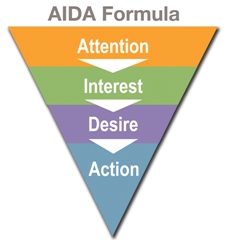
Day 71 - Tip Toolbox - AIDA Formula for Content Marketing
If you create copy and content you should know this classic formula that's been used by advertisers and marketers for decades. This framework is used for all media whether it's advertising, emails, websites, radio, etc.
see AIDA

Add the AIDA formula to your toolbox!
see AIDA
- Attention: Get their attention.
- Interest: Keep them interested with interesting facts.
- Desire: Make them really want to buy it.
- Action: Get them to take the action you want.
Friday, October 24, 2014
Day 70 - 7 Persona Characteristics
A persona is a way to model, summarize, and communicate research about customers. The fictional character in a persona is depicted as a specific person but synthesized from observing many customers. Building a persona? It should have these 7 characteristics:
- Social and demographic attributes
- Needs, desires, motivations, goals
- Consumer habits and behaviors
- Expertise
- Cultural background
- Must do, must never
- Customer experience goals
Tuesday, October 21, 2014
Day 69 - 5 Mobile Design Tips We Sometimes Forget
- Lead the user toward the next step.
- Match your interactions to your platform.
- Use clear and simple icons.
- Less is more.
- Not everyone speaks English; remember your international users and see number 3 above!
Day 68 - Interaction Design Tip - One Time Actions
You may need to have users perform an action one time and communicate that the action will not be performed again. For example if the user is doing an install.
- In this case the solution would be a button labeled "install".
- The button can have a subtle animation when pressed.
- Transform the button into a label specifying the result of the action, e.g. "Installing".
These steps can be generalized into other one time actions by using buttons and labels to communicate the status of the actions.
Monday, October 20, 2014
Day 67 - Interaction Design Motion - Disney Animation Principles
With mobile app platforms and emerging technologies becoming more immersive and dynamic, it's important to understand animation as a ux or interaction designer.
These are Disney's 12 Rules of Animation:
These are Disney's 12 Rules of Animation:
- Squash and stretch
- Anticipation
- Staging
- Straight ahead / pose-to-pose
- Follow through / overlapping-action
- Slow in and out
- Arcs
- Secondary action
- Timing
- Exaggeration
- Solid drawing
- Appeal
Subscribe to:
Posts (Atom)